
How an AI Visibility Audit revealed why an established company with a loyal customer base was losing ground to newer competitors, and what we did to close the gap.
At a Glance:
- Client: A specialty ecommerce brand with nearly 30 years of product expertise, loyal customers, and established organic search visibility.
- Challenge: Newer, digitally savvy competitors were becoming increasingly prominent across search and AI-generated product recommendations, while some of the client’s strongest product differentiators weren’t clearly represented online.
- Solution: An AI Visibility Audit combining search behavior, competitive research, and AI visibility analysis to diagnose where the brand was being overlooked and why, followed by focused hands-on implementation targeting the high-value opportunities.
- Outcome: Clearer digital positioning around product quality and differentiation resulting in immediate visibility and traffic improvement, and a repeatable framework.
- Services: AI Visibility Audit, ecommerce SEO, GEO/AEO strategy, competitive research, keyword research, content optimization, on-page SEO, WordPress implementation.
Introduction: Does Being an Established Brand Guarantee AI Search Visibility?
I recently had the pleasure of working with a specialty ecommerce company that has been selling its products for nearly 30 years.
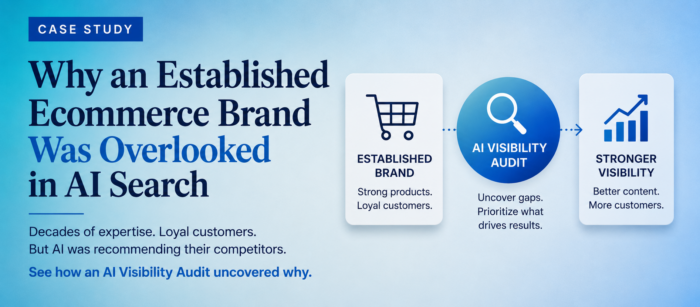
The profile should have made AI visibility a given: it had longevity, loyal customers, deep product expertise, a reputation for quality, and products customers had owned and used for decades.
Unfortunately, that’s not always how SEO or AI Search (GEO/AEO) works.
Why Leading Companies Aren’t Always Visible By Default
This wasn’t a company starting from zero.
The brand already had meaningful organic search visibility and decades of real-world credibility. But, like many companies today, this brand is navigating a rapidly shifting competitive landscape.
Newer, digitally savvy competitors had exploded into the category with polished websites, strong lifestyle positioning, glitzy aesthetics, and detailed product content with search best practices applied. And when prospective customers searched Google or asked AI tools for product recommendations, these newer competitors were showing up instead.
That raised an important question: If your company has decades of expertise and authority, why doesn’t AI necessarily know it? That was the question we needed to answer before deciding what to optimize.
From Audit Findings to a Prioritized Strategy
In many tools, you’ll get an endless list of action items. In a good audit though, a handful of high-impact opportunities that are actually worth pursuing will rise to the top.
Rather than trying to optimize an entire ecommerce website, I looked for the intersection of business value, search demand, buyer intent, existing visibility, and competitive gaps.
That helped us identify a focused group of high-value product and category opportunities where stronger visibility could have the greatest potential business impact.
The goal wasn’t to create a giant GEO to-do list. It was to answer a much more useful question:
What should we work on first?
Initial research revealed an important disconnect I often see: the company’s expertise and product quality were evident to its customers, but not nearly as explicit on the website.
For this ecommerce brand, the audit exposed two important gaps.
- Product information wasn’t explicit enough.
Important details about quality, construction, customization, product characteristics, and use cases weren’t always communicated as clearly or comprehensively as they could have been. Differentiators weren’t stated as explicitly online as they were by newer competitors. That matters because search engines and AI systems can’t rely on reputation the way a longtime customer can. They need information they can find, understand, interpret, and connect to the questions people are asking. The competitors were doing a better job of bragging about themselves and backing it up. Their websites frequently provided more explicit information.
- Buying questions weren’t being addressed.
The client revealed that she receives daily emails and outreach from customers with product and purchasing questions. However, only a handful of the existing FAQ content was limited, and it leaned toward transactional questions such as shipping and returns (yes, these are needed too) rather than the product questions prospective customers might ask while researching or deciding what to buy. Product-specific questions needed to be addressed.
The first opportunity was simple, just not necessarily intuitive: close the ecommerce visibility gap by reviewing and addressing:
- product features and specifications
- materials, construction, and quality
- who particular products were designed for
- use cases and buying considerations
- benefits and differentiators
- product comparisons
- lifestyle and gifting applications
The lesson wasn’t simply “just write more copy.” It was to incorporate copy that weaves in the expertise and differentiation in a way AI systems can understand.
From Insights to Action: The Implementation Phase
Nothing will change without strategic implementation, which was addressed next. And you can’t do AI Search by pretending the SEO fundamentals aren’t non-negotiable when it comes to LLM optimization. This includes:
- identifying primary and supporting search terms
- strengthening product differentiation
- adding descriptive subheads
- making important features and benefits more explicit
- incorporating relevant search terminology naturally
- rewriting title tags and meta descriptions
- strengthening internal linking
- improving the clarity and structure of important product information
- addressing buyer questions
- developing FAQ content
Once changes were approved, they were implemented and updated in WordPress.
Measuring What Matters: Early Wins and Engagement Data
Despite some of the promises being made about AI Search, results don’t necessarily appear the moment the work is finished.
Search engines need time to recrawl and reassess updated pages. AI systems operate differently and don’t update their understanding of a company according to a predictable schedule.
The completed page changes had only been live for approximately two weeks when the engagement wrapped. Two weeks is often not enough time to credibly declare victory based on rankings, organic traffic, or AI recommendations.
However, identifying metrics and looking for early indicators of success should be a part of any good AI Visibility engagement.
Measurement included assessing data across:
- Google Search Console:
- priority-page performance
- non-branded search visibility
- keyword visibility
- GA4
- AI referral traffic where available
That said, the post-launch data already points to significant gains:
- Overall Search Growth: Across the five optimized product pages, clicks increased 33% and impressions increased 24% compared with the pre-launch baseline period.
- AI Referral Growth: Traffic from AI assistants increased 80% overall.
- ChatGPT Referral Growth: ChatGPT accounted for 131 of the 136 net new AI-referred sessions and increased 82.4% compared with the baseline period.
- Priority Page Growth: Several optimized pages showed particularly strong early movement, including one page that recorded an 88% increase in clicks and a 71% increase in impressions.
These results are encouraging, but they’re still early. They represent a two-week post-launch benchmark, not proof of long-term performance or causation. A 60-90-day review will provide a much more meaningful picture of how the optimizations are affecting search and AI visibility over time.
What Does This Ecommerce Case Study Teach Us About GEO and AI Search Visibility?
To recap:
- When you’re an expert, you need to be obvious about it, not humble: After nearly three decades in business, the company had considerable expertise and a strong point of view about product quality. Newer competitors were simply better at articulating their own value propositions online.
- Competitors were giving AI more context: Competitors frequently provided richer descriptions, buying information, comparisons, use cases, and other content that made their products easier to interpret and differentiate.
But the biggest lesson from this engagement?
Being established isn’t the same thing as being understood.
A company can have decades of expertise, loyal customers, exceptional products, and genuine authority. But search engines and AI systems don’t experience your reputation the way longtime customers do. They work from information and signals they can access, interpret, and connect.
If newer competitors clearly describe their products, define their differentiation, answer more customer questions, demonstrate their expertise, and earn visibility across the broader web, they can begin to occupy digital territory that an established company assumes it already owns.
Could an AI Visibility Audit Help Your Brand?
If you’re an established company watching newer competitors suddenly appear everywhere, find out why they’re winning and then take action to close the gap. Learn more about my AI Visibility Audit. And, if you need help putting the recommendations into action, I can stay involved for hands-on optimization and implementation. Reach out today.
GEO/SEO |