
Key Takeaways
- Shift Focus to Recommendations: Traditional SEO targets information; AEO (Answer Engine Optimization) targets the recommendation stage where users are ready to decide.
- Master the “Fan-Out”: AI doesn’t just process your prompt; it expands it into sub-queries. To win the final answer, you must be present across the entire “fan-out” cluster.
- Optimize for Entity Mapping: Visibility is won by association. Position your brand alongside industry leaders on high-authority third-party sites to force AI to recognize you as a top-tier peer.
- Target “Constraint” Language: High-intent prompts are defined by specific modifiers (e.g., “for small teams,” “under $100”) that signal a user is moving from education to action.
Just as keyword research is the foundation of SEO, Prompt Research is a critical first step in your AI Search playbook. If you want your brand to be cited and mentioned in LLMs, you have to first focus in on the prompts that matter.
The choice is yours – do you want AI to find and regurgitate your content without giving you attribution, or do you want it to find you, recommend you, and bless you with the gold star – a citation. (Hint: you want the latter.)
What Is Prompt Research for AI Search?
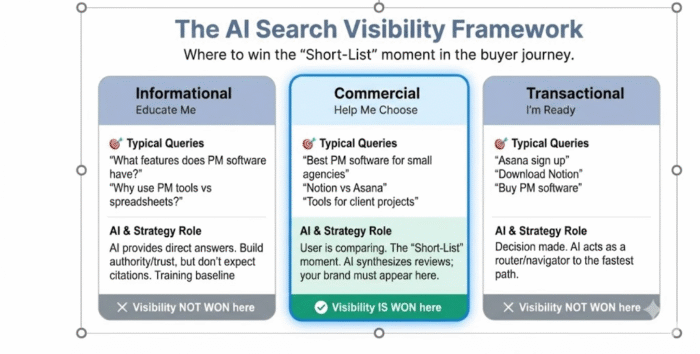
In the era of Answer Engine Optimization (AEO), the heart of prompt research is this: some prompts generate explanations, and others generate recommendations.
As an AI search marketer, you need to care about the latter. Prompt research is specifically about identifying and owning the moments, or prompt queries, which result in a recommendation.
The cold hard truth though, is that most AI queries never reach the recommendation stage.
Like traditional search, a large percentage of AI search is INFORMATIONAL. Someone needs information, receives said information, and gets on with their lives.
How to Identify Decision-Stage Prompts
Let’s role play – imagine you’re the marketer for a project management software company (whew, a highly competitive niche, good luck with that). To win in AI search, you need to move past “what is project management” to find the Decision-stage prompts.
Here’s how you might identify them:
- Identify and use language cues – look for prompts containing specific “high-intent” modifiers:
- Constraint words: “free,” “under $X,” “no budget,” “quick,” “no setup”
- Personalization fit words: “for beginners,” “for small teams,” “for [industry],” “without needing a developer”
- Risk mitigation words: “without,” “that doesn’t require,” “that actually works,” “that isn’t too complicated”
- Urgency words: “ready to use,” “immediately,” “this week,” “out of the box”
- Stress test it: if an AI can answer a prompt without naming a brand or making a choice, it’s still informational. If the answer requires a recommendation (rather than simply a definition), you’ve found a decision-stage prompt.
Think Like AI: Find Your Prompt, Then Fan Out
Once you identify your decision-stage prompts, the fun isn’t over. You’re going to fan out.

Visualize fewer covert military missions, more query fan out for AI algorithms.
When a user asks: “What’s the best project management tool for a 10-person marketing team that needs Slack integration?” the AI algorithm fans out into sub-queries like:
- Constraint: “best project management tools for small marketing teams working remotely”
- Integrations: “project management tools with native Slack integration”
- Comparison: “Asana vs Monday vs ClickUp vs Notion”
- Pricing Model: “per-seat pricing vs flat rate or small teams”
- Use Case: “built for marketing workflows and campaigns”
- Sentiment: “Reddit threads on most affordable PM tools for teams of 10”
AI retrieves answers to all of these sub-queries and reassembles them into a single recommendation.

Recap – Go Beyond the Prompt
AI doesn’t just answer your prompt question, it breaks it into a cluster of sub-queries, retrieves answers to each, and reassembles a response. It will answer 5-10 questions the user never knew they were looking for but always wanted.
Is it any wonder users love LLMs for search and traditional traffic is declining?
What this means for brands, is that brand visibility isn’t won on a single keyword or page anymore. You need to show up across the full cluster and across the ecosystem of reviews, forums, comparison guides, social media, and of course, your owned content.
And at the end of the day, isn’t this actually genuinely helpful and valuable to a user? That’s what I like about AEO/GEO actually – at the end of the day, we’re improving the experience, which is what it’s all about.
Prompt Research FAQs
Traditional SEO focuses on ranking in a list of search results. AEO (Answer Engine Optimization) and GEO focus on being the direct answer or the recommended brand within an AI-generated synthesis.
Apply the “Choice Stress Test.” If the AI can answer the prompt without making a recommendation (e.g., just providing a definition), it is informational. If it requires choosing a brand or solution, it’s a high-value decision-stage prompt.
Absolutely. AI models use traditional search indexes to find data. High-quality content, good technical SEO, and mobile-friendliness remain the baseline requirements that allow AI engines to find and trust your site in the first place.