
Many businesses checking whether they’re visible in AI search are taking the wrong approach. They start with informational queries—“how to do X” and “what is Y.” That was great fodder for cementing authority in the SEO era, but it’s not where the real opportunity lives now.
Those prompts and that audit direction will guarantee your content gets scraped—and most likely, not cited. Early in a user’s research journey, AI functions like an encyclopedia. But as a prospect moves from learning into evaluation mode, the model starts functioning more like a consultant: making recommendations, comparing options, and pointing toward specific providers.
It’s those later-stage prompts you need to use when evaluating your AI search presence—or lack thereof.
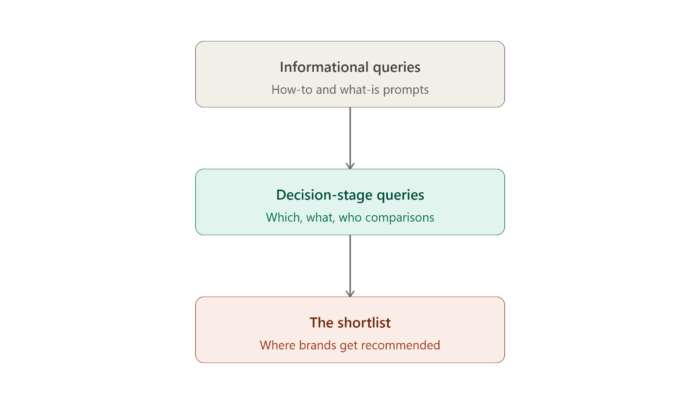
Which, What, Who: The Golden Ticket Prompts for AI Visibility
The prompts that matter most for commercial visibility aren’t instructional. They’re evaluative. These are what I call Decision-Stage Prompts, and they tend to start with three words:
- Which — “Which agencies specialize in B2B rebranding?”
- What — “What are the best solutions for enterprise onboarding?”
- Who — “Who has experience with SaaS visual identity?”
These reflect people who aren’t looking to learn. They’re looking to shortlist.
And your goal? Be on that shortlist.
How to Get Your AI Search House in Order
Here are three things you can do right now to move the AI visibility needle:
1. Audit Your Brand for Reinforced Positioning
Traditional SEO was built around keywords. AI search is built around entities—recognizable, consistent, trusted brands that the model can confidently corroborate across many sources, both on-site and off-site. Stake your claim and communicate it everywhere, consistently.
2. Be Clear, Not Clever
LLMs skim for fast, factual answers to specific prompts. Vague, cutesy, or non-existent copy holds you back. If a language model can’t immediately understand what you do, who you serve, and why you’re credible—you’re invisible to it.
3. Make It Easy for AI to Find and Feature You
AIs are like smart, hungry, single-minded toddlers who have spotted the cookie jar: motivated, ready to go, and looking for the fastest route to get there. Schema markup, structured content, and a well-organized site make you the obvious grab. Give them the easy path.
The Bottom Line
In the age of AI search, you don’t just want to be a scraped source. You want to be the recommendation.
Plant your stake in the ground. Show up consistently as a recognized entity. Communicate in clear, not clever language. Structure your website so LLMs react favorably to it. And let me know when leads start reaching out saying, “I found you in ChatGPT.”
Frequently Asked Questions
What are Decision-Stage Prompts?
Decision-Stage Prompts are evaluative AI queries—typically starting with “which,” “what,” or “who”—that prospects use when they’re ready to compare providers and make a shortlist. They signal buying intent, making them the most commercially valuable queries to appear in.
How do I know if my brand appears in AI search results?
Run Decision-Stage Prompts in ChatGPT, Perplexity, Claude, and Google’s AI Overviews using your niche and service type (e.g., “Who are the best B2B brand strategists?”). If your name doesn’t appear, that’s your benchmark—and your opportunity.
What is GEO (Generative Engine Optimization)?
GEO, or Generative Engine Optimization, is the practice of optimizing your content and online presence so that AI language models are more likely to surface, cite, and recommend your brand. It focuses on entity consistency, structured content, schema markup, and clear factual positioning—rather than keyword density alone.
GEO/SEO |