
How I helped a creative agency become easier to find, understand, and recommend across traditional and AI search.
At a glance:
- Client: a boutique creative branding agency upping their AI visibility game while undergoing a rebrand and domain transition.
- Challenge: Generate visibility in AI search tools to generate high-quality leads while mitigating the risk of lost SEO authority and brand confusion during a rebrand and domain change.
- Solution: a 3-month engagement beginning with an AI Search Visibility Audit, hands-on SEO migration support, tactical optimization implementation, GA4 conversion tracking setup, and an off-page roadmap customized to the competitive landscape.
- Outcome: SEO and GEO foundation implemented, clear brand entity mapping across major search and AI engines, actionable vertical positioning, and a framework for continuing achievable growth and visibility.
- Services: AI Visibility Audit, SEO migration, GEO/AEO optimization, analytics, competitive research
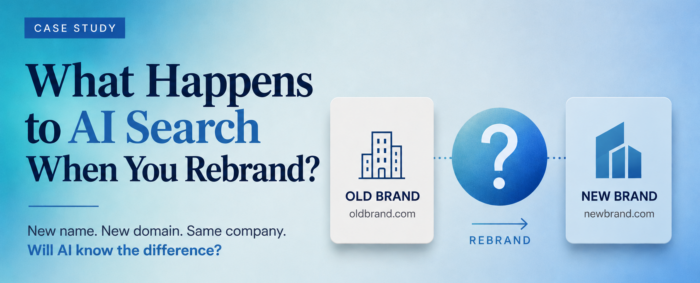
Introduction: What happens to AI search visibility when a company rebrands?
When a company changes its name and domain, search engines and AI systems need clear signals connecting the old brand to the new entity. Redirects and traditional SEO migration work help preserve search equity, while consistent brand information across the website, structured data, business profiles, directories, media mentions, and other third-party sources help reinforce that the new brand is the same established company. Without those connections, authority and brand signals can become fragmented.
The Challenge: A New Brand, A New Domain, and Visibility Risk
When an established, ambitious design and branding agency initially reached out, their motive was one shared by many creative agencies today facing declining organic traffic and traditional visibility: improve lead generation by getting recommended when prospective buyers ask AI tools like ChatGPT, Claude, and Gemini for specialized agency partners.
How Do You Protect SEO and AI Visibility During a Rebrand?
What began as a straightforward Generative Engine Optimization (GEO) project instantly expanded when a trademark issue forced the agency to undergo a rebrand and migration alongside the GEO effort, adding challenges that required.
- Preventing the agency from losing its established domain authority and equity
- Closing a risky AI perception gap by rapidly updating third-party ecosystem signals (directories, industry roundups, social profiles, and media mentions) so AI models wouldn’t hallucinate, split authority, or treat the new brand as an unverified startup.
- Build a search and AI visibility foundation from scratch under the new name so search engines and AI tools could confidently find, understand, and recommend them.
Why Does a Rebrand Require Specialized GEO Services?
Rebrands inherently create major visibility risks. When paired with the way AI models draw on web-wide corroboration to make recommendations, a new name, new domain, new messaging, and new positioning can create confusion for search engines, AI tools, and prospective buyers if the transition is not handled intentionally.
Search engines and AI models get confused by fragmented entity signals, conflicting information, weak corroboration, outdated references, and inaccessible content, leading to dropped rankings and missed buyer recommendations.
Why This Engagement Needed Strategy and Implementation – not just another GEO Audit
The agency didn’t just need standard SEO tactics or a fancy GEO strategy deck – they needed an SEO/GEO expert to create alongside them an active, adaptable framework to protect their past reputation while positioning their new brand for future discovery.
GEO/AEO needs require both a strategic view and a practical implementation sprint. Not just “Clarify your positioning,” or “Build more authority,” or “Improve entity alignment.”
Proper GEO/SEO/AEO services today require incorporating a full look at the individual pieces:
- the brand’s assets and website
- current search visibility performance
- dissection of AI-generated answers
- a strong technical setup and content structure
- analytics and conversion tracking
- migration support
- off-page social and PR opportunities
- future vertical growth
Connecting the strategic “How should this agency be understood and recommended” with “Can search engines, AI tools, and reporting systems actually see the right signals” is where the rubber meets the road for AI visibility.
7 Steps for AI Search Strategy & Implementation
The engagement focused on the following:
- Understanding how the agency showed up in search and AI discovery
- Identifying who was being recommended and how to close the gap
- Clarifying positioning around priority verticals
- Finding technical issues that were affecting visibility
- Supporting the rebrand and domain transition
- Setting up better measurement and reporting
- Creating a roadmap for what comes next
Let’s dive in.
1. Understanding how the agency showed up in search and AI discovery
Evaluating how the agency appeared across traditional search and AI discovery environments, including prompts tied to its services, verticals, and buyer use cases included reviewing:
- how the agency showed up by name
- whether AI tools recognized the rebrand
- which competitors were being recommended for priority buyer prompts
- which sources and citations were influencing AI-generated answers
- where the agency’s website, messaging, and third-party footprint needed to become clearer
This moved the conversation from ambiguity to begin with concrete visibility intelligence.
2. Identifying who was being recommended and how to close the gap
A major part of an AI Search engagement involves reviewing the competitive landscape across both organic search and AI discovery.
It involves identifying which agencies were visible for relevant search terms and AI prompts, then identifying the patterns behind that visibility. The most visible competitors all had several characteristics in common:
- more explicit positioning language
- stronger service and vertical pages
- thematic content hubs
- clearer case study framing
- stronger social proof
- more third-party validation through awards, roundups, podcasts, and industry mentions
The results did not follow the broad, generic GEO advice you hear, like “get on Reddit” and “create YouTube videos.” The agency did not need to follow generic “one size fits all” recommendations.
It needed to claim its expertise, make it more visible, easier to understand, and easier for outside sources and AI systems to corroborate.
3. Clarifying positioning around priority verticals
The agency had valuable experience across several categories, but some of that expertise was not being stated as clearly or directly as search engines and AI systems need.
That is common with creative and expert-led companies.
Creative copywriting can be compelling to a human buyer, but too abstract for search engines and AI tools to confidently categorize.
We identified opportunities to clarify positioning around priority areas including wellness, healthcare, hospitality, and future vertical expansion.
4. Finding technical issues that were affecting AI visibility
Beyond the visual aesthetics of a website, improving what happens underneath the surface where AI systems access and interpret is a critical component of a GEO audit.
Often, visually appealing websites can unintentionally hinder crawlers from accessing and extracting content, especially on sites that depend on JavaScript, animation, and lack clear page structure.
When important website content is difficult for crawlers to access or extract, it creates another potential barrier to its discovery, understanding, and use by search and AI systems. The point of a technical GEO/AEO review is to preserve the brand experience while identifying ways to keep a site readable and AI-friendly.
5. Supporting the rebrand and domain transition
The rebrand became a priority visibility component to address: how to move from the old brand to the new brand without losing discoverability or creating confusion for search engines, AI tools, and prospective buyers.
The migration was supported through:
- a holistic and comprehensive rebrand visibility review
- domain and Search Console recommendations
- redirect and migration considerations
- brand and entity consistency checks
- recommendations for reinforcing the new name across owned and third-party channels
Intentional and proactive work before, during, and post-migration ensured the new brand would be findable, understandable, and connected to the company’s existing expertise.
6. Setting up better measurement
Before the engagement, the agency did not have a clear way to evaluate if SEO/GEO was working to drive leads.
Because GEO/AEO measurement is still directional and relies on patterns rather than the precise, attributable metrics that paid channels are accustomed to, various reports need to be reviewed to assess growth.
A key conversion report was set up in GA4 to evaluate contact form submissions by channel, providing the agency with visibility into where high-quality leads were coming from, including AI referral traffic and organic search.
Every day, qualified prospects are searching for and receiving recommendations for solutions throughout the buying cycle. While we AI Search Marketers wish attribution were clearer and more direct, there are still ways to connect with and assess the actions that matter.
The reporting setup gave the team a better way to evaluate future visibility work against actual business outcomes.
7. Creating a roadmap for growth
A good SEO/GEO audit and implementation engagement should finish with a clear path for ongoing growth and building upon the set foundation, as this agency GEO engagement did.
The biggest next-step opportunity was not simply more on-page SEO; it was focused on claiming and amplifying the expertise they already had, and leaning into their new brand positioning.
To become a more consistent answer in AI and search discovery, that expertise needed to be reinforced beyond the website.
The next-stage recommendations included:
- strengthening authority in priority verticals
- building visibility through PR and thought leadership
- pursuing roundups, podcasts, and third-party mentions
- creating more explicit content around priority expertise areas
- expanding into the next strategic vertical using a repeatable process
- using social media and Google Business positioning to reinforce focus areas
- continuing to monitor visibility, search behavior, and contact submissions over time
This next phase matters because AI systems do not rely only on what a company says about itself.
They also look for corroboration.
What Were the Results of the 3-Month SEO/GEO Engagement?
By the end of the 3-month engagement, the team had:
- a strong search and AI visibility foundation for the new brand
- a clearer understanding of how the agency was being interpreted by search engines and AI tools
- a more focused positioning direction around priority verticals
- a better understanding of which competitors were being recommended and why
- technical recommendations to make important site messaging more readable and accessible
- GA4 key event tracking for contact form submissions to continue measurement
- a prioritized, customized roadmap for PR, content, off-page validation, and ongoing visibility growth
- a repeatable process for building future vertical pages and content
When an agency starts a GEO/AEO engagement with the fundamentals already in place, a 3-month engagement for a B2C brand can often deliver measurable sales impact relatively quickly.
B2B is different. With longer, more complex buying cycles (and when a client is starting from zero visibility and needs foundational work first) a 3-month engagement won’t produce a traffic spike, and shouldn’t be expected to (despite what many GEO/AEO agencies try to make you believe).
Instead, success looks like a clear roadmap for content and structure, early gains in visibility for key buying-stage queries, and an ambitious yet realistic pipeline strategy the team can execute against with confidence.
What Does This Rebrand Teach Us About GEO and AI Search Visibility?
One tactic or technique is not going to get the job done. A holistic review and approach are needed.
A lot of companies are told that if their website structure is clearer, if they get on Reddit, if they get more PR, they will become recommended instantly.
But both search engines and AI tools need a variety of signals they can read, interpret, and verify.
If those signals are vague, fragmented, hard to crawl, or not reinforced by third-party sources, even strong agencies can be overlooked. That is especially true after a rebrand, a domain change, a positioning shift, or a move into a more specific market category.
The most valuable work in an AI visibility engagement is not always the flashiest.
Sometimes the win is:
- identifying why competitors are being recommended instead
- making the website easier to read and interpret
- setting up better measurement
- clarifying the next authority-building moves
- creating a roadmap the team can keep using after the engagement ends
That foundation, although often unglamorous, is what makes future visibility growth possible.
Could This Be You?
Want to see how your brand actually shows up in AI Search and how to gain meaningful results that result in growth?
This kind of work is not only relevant for agencies and companies going through a rebrand. It is also relevant if:
- you have a strong reputation, but AI tools are not recommending you
- competitors show up in AI answers and you do not
- your website looks polished, but your positioning is still too vague
- you are trying to become known for a more specific category, service, or audience
- you have content, but not a clear authority-building strategy
- you are getting traffic, but not sure which channels drive real inquiries
- you are investing in PR or thought leadership, but do not know what visibility gaps it should support
- you suspect buyers are researching your category differently now, but you have not checked how you show up
That is exactly where an AI visibility audit can help.
If you’re wondering whether people can find you when they ask tools like ChatGPT, Google AI Overviews, Gemini, Claude, or Perplexity for recommendations, that’s exactly what the Lead Gen AI Visibility Audit is for.
I’ll show you where you’re showing up today, where you’re not, who’s getting recommended instead, and what’s actually blocking you from being more visible across search and AI systems. And if you need expert hands-on help, I can do that too.
Request a Lead Gen AI Visibility Audit and I’ll send you a clear breakdown of what’s working, what’s not, and what to fix first so that you can add AI Search as a lead-generating channel.
About Jenny
Jenny Munn is an SEO and AI Visibility Consultant who helps organizations improve visibility across Google and AI search platforms through technical SEO, GEO/AEO strategy, content optimization, competitive research, and hands-on implementation.
GEO/SEO |