
Key Takeaways:
- Most marketing teams jump to AI search tools before fixing the inputs that actually determine visibility
- AI-powered answer engines reward content with authority signals, structured data, and real buyer intent – not just keyword optimization
- Visibility and discoverability are now two different problems, and most B2B teams are solving the wrong one
- Optimizing existing content beats creating new content (if you have great, still-aligned content), as structure and signal matter more than volume
- If you don’t know how your brand performs in AI search for your most important topic, you’re flying blind on pipeline
There’s a pattern I see consistently with B2B marketing teams right now.
They hear “AI search optimization” and immediately jump to tools. They start prompting ChatGPT, downloading browser extensions, or asking their agency to “add AEO to the retainer.” They’re moving fast, but they’re moving fast in the wrong direction.
Here’s what they’re missing.
The Problem Isn’t Tools. It’s Inputs.
AI-powered answer engines – ChatGPT, Perplexity, Google AI Overviews- don’t reward the teams with the best tools. They reward the brands with the best inputs.
What do I mean by inputs? Context. Audience intelligence. Proof. Specificity. The kind of substance that tells an AI system: this brand knows what it’s talking about, and it’s relevant to this query.
When your content lacks that substance, no tool fixes it. You’re just automating mediocrity faster.
Most Content Isn’t Built to Be Retrieved
Here’s the hard truth: the majority of B2B thought leadership content (the blogs, the case studies, the podcasts) wasn’t written with AI retrieval in mind. It was written for skimming humans, or as a checkmark for adding additional copy touting your services. Not for language models evaluating authority and relevance.
That doesn’t mean it’s bad content or that all hope is lost. It means it needs to be restructured.
AI systems are looking for:
- Clear, declarative answers to real buyer questions
- Authority signals and expertise markers
- Structured data that makes content easy to parse
- Consistency between what you say you do and how your content demonstrates it
If your pages aren’t built around these signals, you’re not likely to get cited, referenced, and linked, no matter how good your underlying expertise is.
Visibility and Discoverability Don’t Mean What They Used To
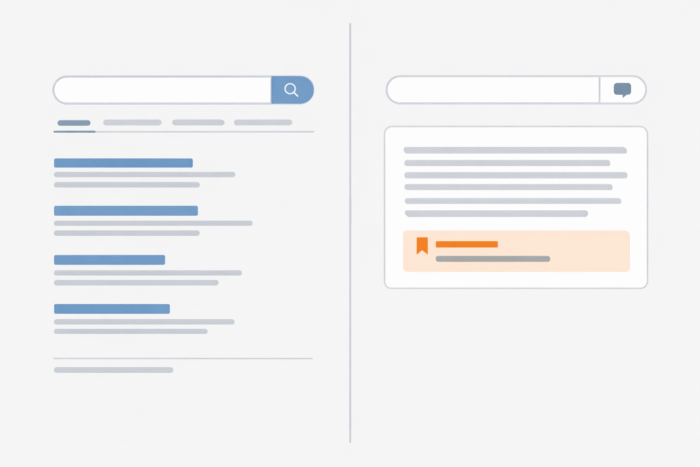
This is the shift most teams haven’t fully reckoned with yet.
Traditional visibility used to be about real estate. Are you on Page 1? In the Local Map Pack? The game consisted of ranking specific URLs for specific keywords.
Now, discoverability in the AI search era means being the brand an AI system surfaces, cites, and recommends when a high-intent buyer asks a question you should own. AKA – retrievable. It’s about your brand’s facts and entities, and that they are understood and trusted by LLMs.
Discoverability is now about being the answer. And the gap between teams who understand that and teams who don’t is widening every month.
What Actually Works
After 15 years in SEO, and the past couple of years deep in AEO and GEO, here’s what I know moves the needle:
- Start with your most important topic, not your whole site. Pick the one topic hub most connected to your pipeline. That’s where you optimize first.
- Fix existing content before creating new content. Most companies have more than enough raw material. The issue is structure and signal, not volume.
- Build for agentic AI, not just today’s search. The way AI agents discover, retrieve, and evaluate content is already changing. What you optimize today should account for where this is heading, not just where it is.
- Measure outcomes, not activity. AI citations, qualified referral traffic, lead quality — those are the signals that matter. Not impressions, not rankings.
The Bottom Line
Your buyers are already using AI-powered search to research vendors, compare options, and build shortlists. If your brand isn’t showing up in those moments, someone else’s is. Most marketing teams are underestimating how fast the gap is growing.
If you’re not sure where your brand stands in AI search for your most important topic, that’s exactly what the AI Visibility Snapshot is designed to answer. In 4 weeks, with real deliverables and a system your team can actually use.
AI Search for Marketing Teams – FAQs
SEO optimizes content for traditional search engines like Google. AEO (Answer Engine Optimization) and GEO (Generative Engine Optimization) optimize content to be retrieved, cited, and recommended by AI-powered answer engines like ChatGPT, Perplexity, and Google AI Overviews. The goal shifts from ranking to being the answer.
Most existing content wasn’t structured for AI retrieval. It lacks the authority signals, structured data, and direct answer formats that AI systems use to evaluate and cite sources. The fix usually isn’t creating more content — it’s restructuring what you already have.
Any B2B company that relies on content to drive awareness, consideration, and leads. If your buyers are using AI-powered search to research vendors and evaluate options (and they are), your content needs to show up in those moments.
The fastest way is to search for the questions your buyers ask in ChatGPT, Perplexity, and Google AI Overviews and see if your brand appears. A more thorough evaluation looks at your content structure, authority signals, and competitive gaps – which is exactly what the AI Visibility Snapshot covers.
Traditional SEO rankings tell you where you appear in a list of results. AI search visibility determines whether you’re cited, recommended, or surfaced at all when a buyer asks a question you should own. They require different strategies – and ignoring the latter is an increasingly costly mistake.